Don't Launch It.
Build It.
The biggest constraint in space exploration is the rocket fairing. In-Space Manufacturing (ISM) allows us to launch compact raw materials and print massive structures directly in orbit.
The biggest constraint in space exploration is the rocket fairing. In-Space Manufacturing (ISM) allows us to launch compact raw materials and print massive structures directly in orbit.
Currently, any telescope or space station must fold up like origami to fit inside a 5-meter rocket nose cone. This involves complex hinges and high risks of failure.
The Solution: Launch a spool of plastic or metal (dense cargo) and a 3D printer. The printer can extrude a truss that is 1 km long—impossible to launch in one piece.
Concept: Similar to a desktop 3D printer but open-ended.
A robot (like the "Archinaut") extrudes high-strength polymer beams endlessly into the vacuum. These beams form the skeleton for solar arrays or telescopes.
Concept: Using sunlight as a laser.
A lens concentrates sunlight onto a bed of asteroid dust (regolith). The heat melts the dust into solid rock or glass bricks, used for building radiation shields.
Concept: Electron Beam Melting (EBM).
Using electron beams to melt metal wire in a vacuum. This creates high-strength aluminum or titanium parts for repairing ships without needing spare parts from Earth.
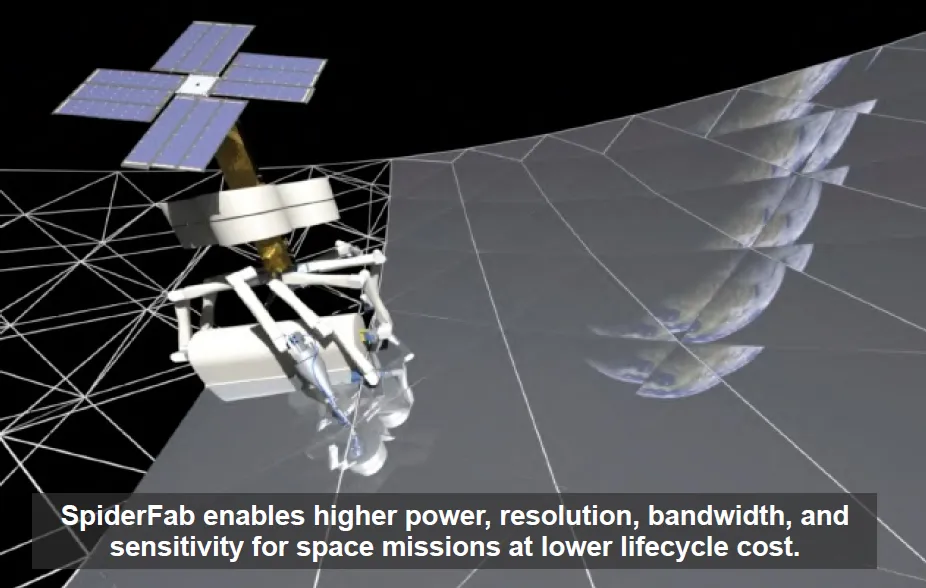
A NASA-funded concept by Tethers Unlimited. A small robot spins a carbon-fiber truss structure much larger than itself, similar to how a spider spins a web.